The Norwegian 4×4 Protocol: The Science-Backed Way to Rapidly Boost VO2 Max
Introduction: Why Standard Cardio Isn’t Enough
Many people spend hours on the treadmill at a steady, moderate pace. While this is excellent for general health, it often isn’t enough to significantly move the needle on your VO2 Max—the gold standard of cardiovascular fitness.
If you want to improve your heart’s efficiency and increase your lifespan, you need a specific type of stimulus. Enter the Norwegian 4×4 Protocol. Developed by researchers at the Norwegian University of Science and Technology (NTNU), this method is widely considered the most effective way to improve aerobic capacity in the shortest time possible.
What is the 4×4 Protocol?
The Norwegian 4×4 is a form of High-Intensity Interval Training (HIIT) specifically designed to maximize stroke volume—the amount of blood your heart pumps with each beat.
The structure is simple but intense:
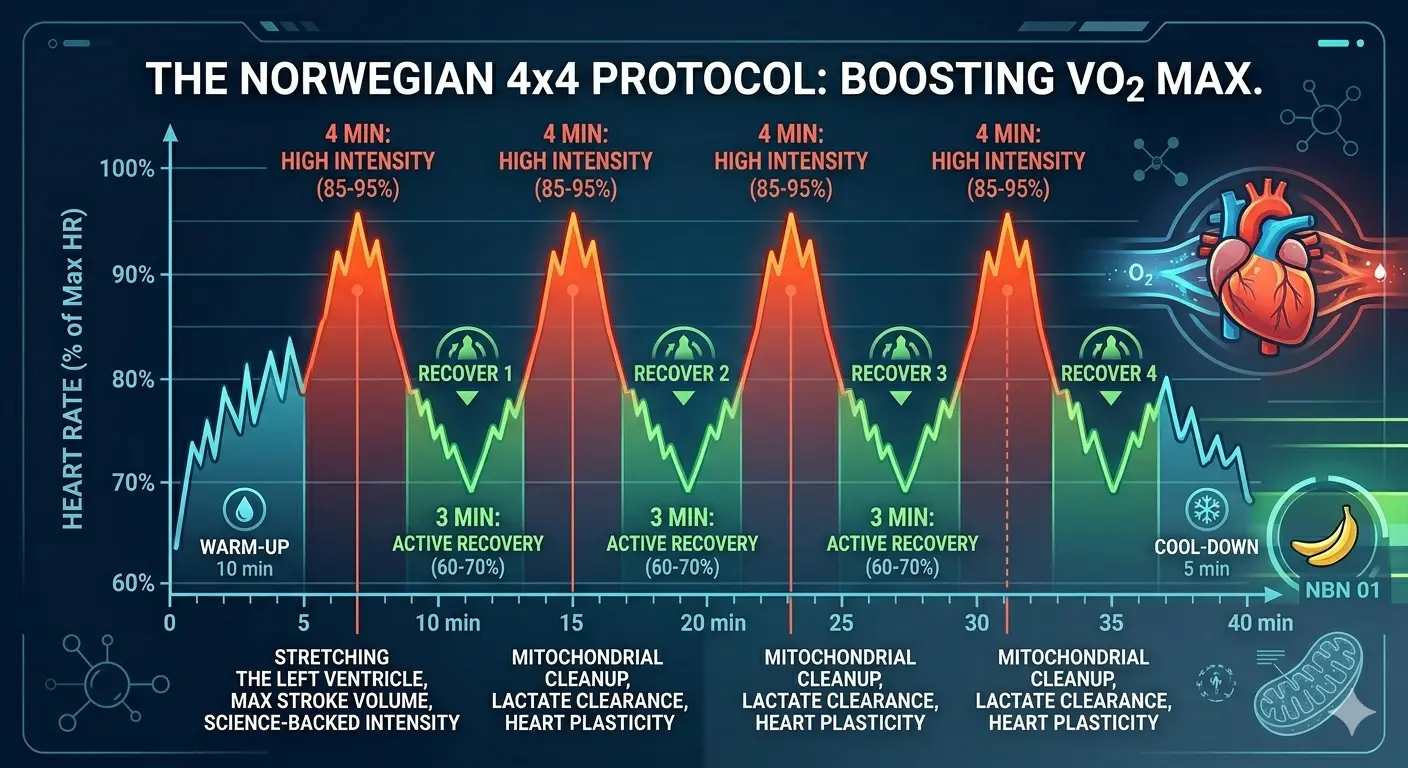
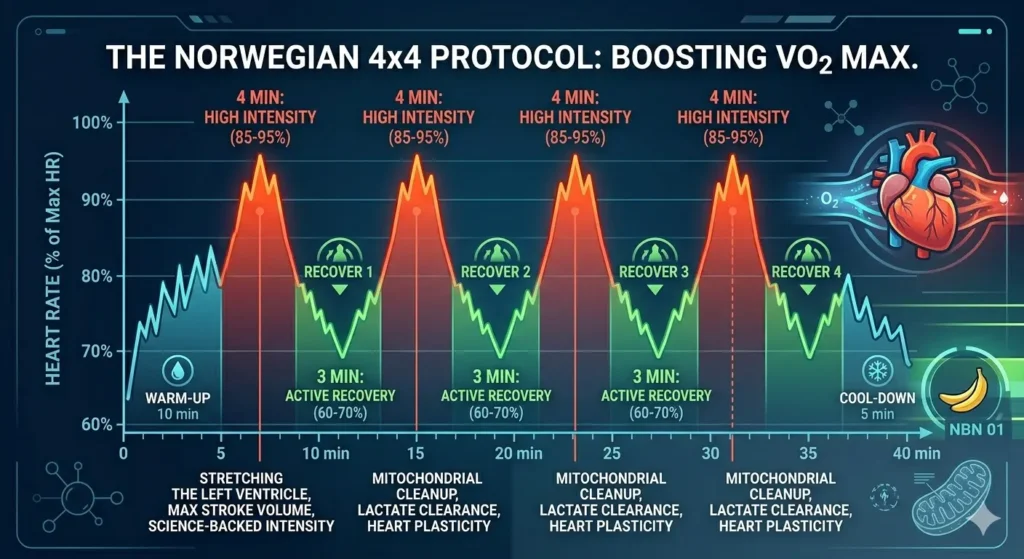
- 4 Minutes of High Intensity: You work at 85% to 95% of your maximum heart rate. You should be breathing hard enough that you can only manage one-word answers if someone speaks to you.
- 3 Minutes of Active Recovery: You drop down to a light jog or brisk walk (around 60-70% of max heart rate) to let your heart rate recover slightly before the next round.
- Repeat: You perform this cycle a total of four times.
Total time: Approximately 40 minutes (including a 10-minute warm-up and 5-minute cool-down).
The Science: Why 4 Minutes?
Why not 30 seconds or 10 minutes? Research shows that it takes about two minutes for your heart to reach its maximum pumping capacity during an interval. By doing 4-minute intervals, you spend a significant amount of time (8 minutes total across the session) at your peak cardiovascular limit.
This sustained pressure forces the heart’s left ventricle to stretch and strengthen, allowing it to pump more oxygenated blood to your muscles and brain.
How to Implement the 4×4 Protocol Safely
Before starting, ensure you have a solid “base” of at least 4-6 weeks of regular Zone 2 (easy) cardio.
- Frequency: For most people, once or twice a week is plenty. Doing this every day will lead to overtraining and injury.
- Modality: You can do this running, cycling, rowing, or even on an elliptical. The key is reaching the target heart rate.
- Tracking: Use a chest strap heart rate monitor for accuracy. Wrist-based sensors often struggle to keep up with the rapid changes in intensity during HIIT.
Scientific References (E-E-A-T)
This protocol is backed by decades of clinical research in both healthy individuals and heart disease patients.
- Medicine & Science in Sports & Exercise: A study comparing different training intensities found that the 4×4 interval method was significantly superior to continuous moderate-intensity training for increasing VO2 Max (Helgerud, J., et al., 2007).
- Circulation: Research indicates that this specific protocol can even reverse signs of cardiac aging and improve heart plasticity (Howden, E. J., et al., 2018).
References:
- Helgerud, J., et al. (2007). Aerobic High-Intensity Intervals Improve VO2max More Than Moderate Training. Medicine & Science in Sports & Exercise. [Link: https://pubmed.ncbi.nlm.nih.gov/17414399/]
- Howden, E. J., et al. (2018). Reversing the Effects of Sedentary Aging on the Heart. Circulation. [Link: https://pubmed.ncbi.nlm.nih.gov/29311142/]