The Science of Autophagy: How Intermittent Fasting Triggers Your Body’s Cellular “Cleanup”
Introduction: The Body’s Internal Recycling System
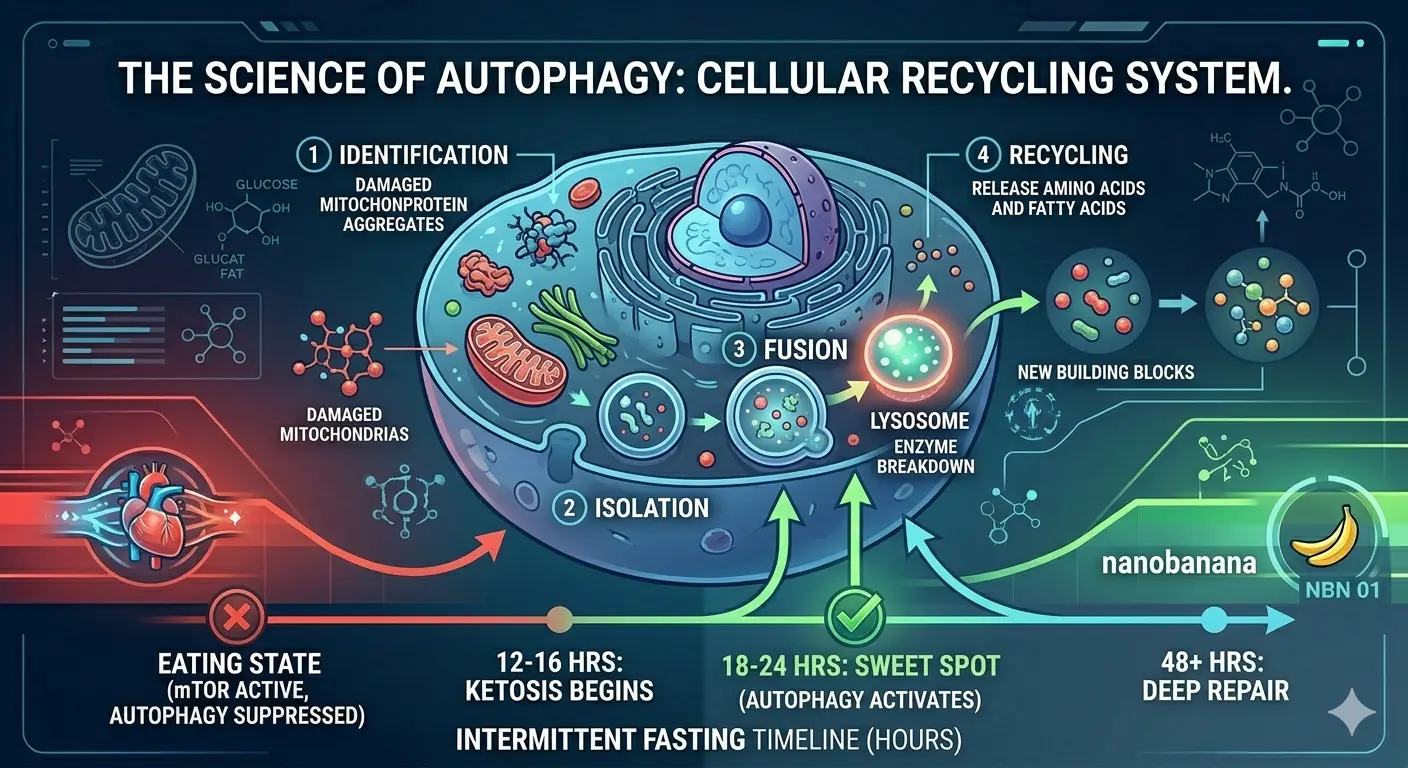
Imagine if you never took the trash out of your house. Eventually, the clutter would make it impossible to function. Your body is no different. Every day, your cells accumulate damaged proteins, broken organelles, and metabolic waste. If this “cellular trash” isn’t removed, it leads to inflammation, rapid aging, and disease.
Fortunately, your body has a built-in recycling program called Autophagy. In this guide, we will dive into the biological mechanisms of autophagy, how it slows down the aging process, and how you can use intermittent fasting to switch this system on.
What is Autophagy? (The Trash-Man Analogy)
The word autophagy comes from the Greek auto (self) and phagein (to eat). It literally means “self-eating.” While that might sound scary, it is actually a vital survival mechanism.
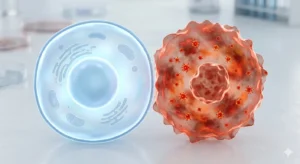
During autophagy, your cells identify old or dysfunctional components and ship them to a specialized organelle called the Lysosome. The lysosome contains enzymes that break down this waste into its basic building blocks (amino acids and fatty acids), which the cell then “recycles” to create new, healthy structures.
This process was so revolutionary to our understanding of health that the researcher Yoshinori Ohsumi was awarded the Nobel Prize in Medicine in 2016 for discovering the genetic pathways that control it.
How Intermittent Fasting Triggers the “Cleanup”
The primary trigger for autophagy is nutrient deprivation. When you eat constantly, your body is in an “anabolic” (growth) state, driven by high insulin and a protein called mTOR. As long as mTOR is active, autophagy is suppressed.
To flip the switch to a “catabolic” (repair) state, you must lower insulin and suppress mTOR. This is where Intermittent Fasting comes in.
The Autophagy Timeline:
- 12-16 Hours: Insulin levels drop, and your body begins to transition into mild ketosis.
- 18-24 Hours: This is the “sweet spot” where autophagy significantly increases. The body realizes no external fuel is coming and begins looking for internal “trash” to burn for energy.
- 48+ Hours: Deep autophagy occurs, potentially leading to immune system regeneration.
The Benefits of Cellular Recycling
- Anti-Aging: By removing “senescent” (zombie) cells that cause inflammation, autophagy keeps your tissues biologically younger.
- Neurological Protection: Autophagy helps clear amyloid-beta plaques in the brain, which are linked to Alzheimer’s and cognitive decline.
- Metabolic Health: It improves insulin sensitivity by cleaning up the mitochondria (the cellular power plants), linking back to our concept of Metabolic Flexibility.
Scientific References (E-E-A-T)
Autophagy research has shifted from theoretical biology to a cornerstone of modern longevity medicine.
- Nature Reviews Molecular Cell Biology: A comprehensive look at how autophagy protects against metabolic syndrome and neurodegeneration (Levine, B., & Kroemer, G., 2019).
- The New England Journal of Medicine: Research on intermittent fasting confirms its role in triggering adaptive cellular stress responses, including autophagy (de Cabo, R., & Mattson, M. P., 2019).
References:
- Levine, B., & Kroemer, G. (2019). Biological Functions of Autophagy Genes: A Disease Perspective. Nature. [Link: https://pubmed.ncbi.nlm.nih.gov/30622347/]
- de Cabo, R., & Mattson, M. P. (2019). Effects of Intermittent Fasting on Health, Aging, and Disease. NEJM. [Link: https://pubmed.ncbi.nlm.nih.gov/31881139/]